

Overview
You have been to the outpatient clinic for an appointment with your orthopedic surgeon. As a result of your complaints and the abnormalities on the X-ray you have jointly decided to have an artificial knee placed to reduce your complaints. Such an operation is no small matter and the rehabilitation requires a lot of willpower and effort from you and from your immediate environment, such as family members and friends. Good preparation and good information will contribute to a speedy recovery. The rehabilitation process is intended to support you in this as well as possible. It is important that you are accompanied by someone who can visit you regularly, so that this person is also fully aware of the journey to be followed. Your orthopedic surgeon has already explained a few things to you at the outpatient clinic. In this information brochure you can read everything about your operation and the rehabilitation process. There is also a video that shows you in general what your operation entails.
Osteoarthritis of the knee
A common condition of the knee is wear and tear, or osteoarthritis. Osteoarthritis means that the quality of the cartilage of the joints decreases. In this case, it concerns the cartilage of your knee. Below you will find information about the causes of osteoarthritis and its possible treatments.
Causes
Osteoarthritis is usually the result of the natural process associated with aging. Other causes of osteoarthritis include:
- damage to the knee, for example after a bone fracture
- damage to the knee from previous knee surgery such as removing the meniscus
- inflammation such as rheumatism or gout;
- inflammation in the joint.
In addition, there are some (risk) factors that increase the chance of developing osteoarthritis, such as:
- overweight;
- age;
- the position of the legs (O- or X-legs);
- and a physically demanding profession that involves a lot of kneeling, squatting or lifting.
What is osteoarthritis?
The knee is a hinge joint. It consists of three bone parts: the tibia, femur and kneecap. The kneecap is located at the front of the knee. The of these three bones are covered with a layer of cartilage. This cartilage protects the knee and ensures that the knee moves smoothly. In osteoarthritis, the layer of cartilage softens and the amount decreases. The bone responds by hardening and forming outgrowths around the developing cartilage (osteophytes). The result is a knee joint and can become more painful.
Pain complaints and symptoms
Osteoarthritis takes place gradually and the symptoms also gradually develop from mild to persistent pain. Typical for osteoarthritis are starting pain and/or starting stiffness in the first minutes after getting up, getting out of bed or walking after sitting for a while. As you get moving again, the pain will subside and you will be able to move better. So you have to ‘get on the gang’. In the long run, pain and/or stiffness also develop at the end of the day. The distance you can walk becomes shorter. Also, the pain can sometimes disrupt your sleep.
You can also have the latest from:
– a knee that is stiffening
– a grinding and grinding noise with the movement of the knee;
– thickening of the knee due to the inner lining of the knee (mucosal inflammation/synovitis);
– an unstable feeling;
– skew of it.
Examination
Based on your symptoms, you will have an interview and a physical examination with the doctor. In order to determine exactly what is going on, an X-ray is sometimes suggested. This is not always necessary and does not always give the correct picture. Some osteoarthritis abnormalities are not visible on X-rays.


Treatment
Osteoarthritis can be treated in different ways. The orthopedic surgeon will discuss with you which treatment best suits your situation so you can make a choice together. The different treatment options for osteoarthritis have their advantages and disadvantages.
Treat non-surgical
Non-surgical treatment is often recommended first. With this, the complaints can often be brought under control well and for a long time. Possible non-surgical treatments include:
- Adjusting your load and your lifestyle (exercising more, walking daily, or walking instead of running, taking the elevator instead of climbing stairs, etc.). Alternate rest and load and keep moving!
- Physiotherapy focused on fitness, strength and coordination.
- Lose weight (under supervision.
- Pain relief medication. This can be paracetamol or possibly an NSAID (Non-Steroidal Anti-Inflammatory Drugs (such as diclofenac).
- A knee brace
- Injecting corticosteroids.
Surgical treatment
Surgery is a possibility if a non-operative treatment no longer works. There are three options: a leg correction, a half knee prosthesis or a total knee prosthesis. Research has shown that keyhole surgery (in which the knee is cleaned) has no role in the treatment of osteoarthritis in the knee. Usually a total knee replacement is the best choice. Below you will find more information about total knee replacement.
Expectations
The knee prostheses that we use at CMC are used all over the world and are of very high quality. We only use prostheses that have shown very good results in international studies. Keep in mind that the recovery after a TKP can take up to a year after placement. Certainly during the first three months, most people experience that the new knee can sometimes still be painful and swollen. In some cases this can take up to a year. On average, the new knee can bend a little further than a right angle (110 degrees) at most. This result depends on how the knee moved before surgery. An artificial knee is therefore not made to participate in high-impact sports such as basketball or running. You can, however, practice easier sports such as walking, cycling, swimming, etc. Ultimately, most people (85%) are satisfied after a year. The pain is then usually largely gone and one can walk better than before. Sometimes patients have too high expectations, and the result can be disappointing.
The operation
During the operation, the knee is opened. The cut is about eight inches long and runs across the front of the knee. The orthopedic surgeon removes the affected articular surfaces and the menisci, and anterior cruciate ligament. Approximately one centimeter of bone is removed from both the lower and upper leg and adjusted to the shape of the prosthesis. A metal joint surface is attached to the thigh with a type of cement. A synthetic joint surface has been placed on the lower leg, which, together with the upper part, allows the knee to pivot smoothly. In some cases, if the kneecap is very badly worn, it is also partially replaced. The joint capsule is then closed again. The skin is usually closed with staples. After about two weeks, the stitches may be removed at the outpatient clinic of the orthopedist. The operation normally takes 45-90 minutes. After the operation, you will be given antibiotics through the IV for a short time to minimize the risk of infections.
Anesthesia during surgery
Most patients undergo this surgery with a spinal or epidural anaesthetic. This has advantages over a general anaesthetic. An epidural is a local anesthetic in which a very thin needle is inserted into your back to give the anesthetic and pain relief. You cannot move your legs during the anaesthetic. During the operation, you can also choose to have the knee anesthetized from the inside (Local Infiltration Analgesia or LIA) and an extra nerve block (adductor canal block) can be given by the anesthetist at the end of the operation. With these techniques we try to ensure that you have as little pain as possible after the operation, so that you can start moving and practice walking as soon as possible. A few hours after the operation, the feeling in your legs will start to return. Most patients do not experience the insertion of the epidural as painful. You will discuss with your anesthetist whether you will be awake or asleep during the operation. With an epidural, a sedation can also be given so that you do not get much from the operation.
Risks and potential complications
As with other operations, these operations also involve risks and there is a chance of complications. Fortunately, these are rare. Possible risks and complications include:
Infection
A very small percentage (1%) of all patients who receive a new joint develop an infection. This can happen in the weeks/months after the operation, but sometimes it can take years. In such a situation, intensive treatment is required. This often involves multiple operations (revisions) and long-term antibiotics will have to be given. To prevent an infection, you will receive antibiotics through the IV before and after the operation, and the work will be as clean/sterile as possible. Clean wound care is also very important.
Thrombosis
Every surgical patient has an increased risk of thrombosis. This is due to the operation itself, but also because you move less than usual. Thrombosis means that a clot forms in the bloodstream. You will be given daily blood thinners for five weeks after the operation to prevent thrombosis. This does not give a 100% guarantee that thrombosis will not occur after surgery. It is important to tell your doctor if you have had a thrombosis in the past or if it runs in your family.
Letting go
An artificial knee can become loose after ten to about fifteen years. This is almost always accompanied by pain. Usually, the prosthesis must then be replaced by a new knee prosthesis (a revision knee).
Stiffness (arthrofibrosis)
The knee can become stiff from excessive scar tissue formation, especially if the knee is not exercised enough after surgery. This condition of the knee is also known as arthrofibrosis. The full extension of the knee is especially important at an early stage.
Registration of data
Since the beginning of 2022, CMC has been affiliated with the Dutch National Register of Orthopedic Implants (LROI). With the help of this register, we can monitor the quality of prostheses and orthopedic care, compare it internationally and improve it. This registration makes it clear, for example, how long different hip and knee prostheses function properly. We will also use questionnaires to record your experiences and rehabilitation. The register helps the orthopedist to choose a well-performing hip or knee replacement. Your data is registered anonymously. See www.lroi.nl for more information about the register
Before surgery
After you and your orthopedist have decided to place an artificial knee, you will make an appointment to visit the anesthetist for a preoperative screening. You must have blood drawn for this. The anesthetist will, among other things, discuss with you whether you will receive an epidural or general anesthesia during the operation. With an epidural, you may also be given a sedation so that you will receive little or nothing from the operation. If you are being treated by, for example, a cardiologist or lung specialist, in some cases information will be requested from them. When the screening has been completed, the planning department will call you as soon as the date on which you can be operated is known.
Admission/date of surgery/stay
The scheduling department and admissions department will call you about a date for your surgery. If you have a wound or infection just before your admission, please report this immediately. For the generally applicable information with regard to admission and stay at CMC, we refer to the general information.
Usually patients who come for a total knee replacement stay in the hospital between 2 and 5 days. You should be able to go home when the wound is dry and the exercises with the physiotherapist are going well.

After the operation
After the operation you will go to the recovery room. Here you will also remain connected to monitoring equipment, so that we can monitor your bodily functions. When you are fully awake and all bodily functions are in order, you will return to the nursing ward. The nurse of the ward will inform your contact person and he or she may then visit you in consultation with the nursing ward. After the operation you will have an IV in your arm. You will be given antibiotics and extra fluids in this way. You have an increased risk of developing thrombosis (blood clots in the blood vessels) in the period after the operation, partly due to reduced mobility. To prevent this, you will receive anticoagulant medication from your orthopedic surgeon for five weeks after the operation.
Post-treatment
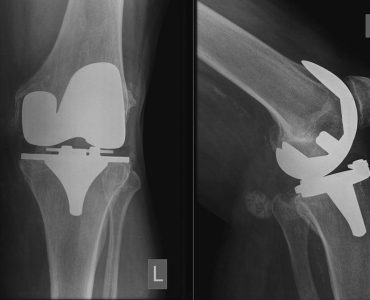
After the operation you will start rehabilitating as soon as possible and a check-up picture will be taken. The physiotherapist will guide you with exercises in bed, with getting out of bed as quickly as possible and learning to walk. You will use a walker first and possibly crutches later. The physiotherapist will also teach you the best way to stand, how to lie down, sit and sleep. You will leave the hospital on foot with an aid (walking frame or crutch) and you will be given certain rules of life. Sometimes you will also receive a referral for a physiotherapist. The number of days you stay in hospital depends on how your rehabilitation is going. About two weeks after surgery, you will return to your orthopedist for a check-up and removal of the stitches. If the wound shows signs of infection after returning home, such as an increase in redness or warmth, fluid leakage from the wound, much more pain or fever, please contact your treating orthopedic surgeon immediately.
Complete Knee Prosthesis operation movie (with permission from the Dutch Orthopedic Association)


Frequently asked questions about a total hip replacement
- How long does a knee replacement last?
- How is the rehabilitation after surgery?
- When will I be fully recovered?
- How long does a knee replacement last?
- Does a knee prosthesis also have limitations?
- How long will my knee stay thick?
- How long should I keep taking the blood thinners?
- How do I care for my wound?
- When can I shower/swim in the sea again?
- When can I go back to work?
- Do I have to wear a compression stocking?
- Could there be problems with airport checks?
- My knee makes clicking noises. Can that hurt?
- Can I kneel or squat with a knee replacement?
- When can I drive a car again?
The lifetime of a prosthesis when used correctly is usually more than 15 years. You could say that more than 90% of patients after 10 years, and about 85% after 15 years still function well with the knee prosthesis. Body weight and activity level have a major effect on the survival of the prosthesis.
Rehabilitation sometimes starts on the day of surgery. The physiotherapist will teach you how to get in and out of a bed or chair and what position you should adopt when sitting and lying down. You will also practice walking with crutches together. From the first moment you can fully support on the operated leg. Patients are often afraid that they could damage the prosthesis, but you don’t have to worry about that. The faster you are back on your feet, the faster the recovery will be.
The first six weeks are the most intensive. You will often need to use crutches during this time. Driving and cycling outside is often not possible. You will also not be able to perform your work properly for six to twelve weeks. Of course, this depends on the type of work you do. After three months you can often resume most daily activities.
The total rehabilitation process can take up to two years and even then 5 to 10% of the patients still have residual complaints to a greater or lesser extent. Fortunately, the vast majority of patients are very satisfied after a knee replacement. Research shows that after six months many patients have much less pain than before the operation and that daily functioning has greatly improved. 8 out of 10 patients indicate that they have recovered much or completely after six months.
The survival time of a prosthesis depends on the load. With normal use, the prosthesis will usually last more than 15-20 years. Body weight and activity level, as you will understand, have a major effect on prosthesis survival. You should avoid peak loads, you can no longer perform certain sports. Heavy physical work such as in construction is also not recommended. Unfortunately, other factors can also negatively affect the survival time of the prosthesis, such as instability, incorrect placement of the components or infection of the prosthesis. These problems will often also cause residual complaints and a reduced satisfaction of the knee.
For most people, the pain is gone after surgery and most normal activities can be resumed. However, not everything is recommended or possible. Kneeling is sometimes difficult after surgery. Heavy sports such as contact sports and running are also discouraged. Bending above 130 degrees puts more pressure on the back of the prosthesis, which could cause it to loosen prematurely. We therefore recommend that you do not bend the knee beyond 130 degrees if that is possible at all. Heavy physical work such as in construction is also discouraged. Such activities and work can seriously affect the life of the prosthesis.
The swelling usually decreases during the first weeks after discharge. The weight gain will be reduced by elevating the legs regularly during the day. The swelling is generally greatest in the evening and decreases if you continue to do the exercises well.
After the operation you should take an injection or tablet once a day against the thrombosis. You should do this until at least five weeks after the operation (if necessary, this will be decided by the general practitioner or specialist). If you are already taking blood thinners before surgery, your doctor will advise you on their use.
The wound should remain clean and dry. The skin around the sutures or staples may appear red or irritated. When the stitches or staples are removed (after about two weeks) this redness will gradually decrease. If the wound area becomes swollen, red or has fluid leaking out, it is wise to contact your orthopedic surgeon.
You may take a shower when the wound is well covered with a plastic bandage. Three days after the sutures have been removed, you can take a bath or shower without a plastic bandage. Do not immediately take a bath or in the sea for an hour or more and do not let the wound soften. It is better to wash the wound with your hands and not with a washcloth for the first two months. Also be careful not to use cream or lotion around the wound area.
Most people are back to work after about 2-6 months, depending on the type of work and the progress of recovery and the advice of the orthopedic surgeon and/or physiotherapist. Light physical work can possibly be resumed earlier.
It is not really necessary to wear a compression stocking, but it does help reduce swelling in the leg. If your leg becomes thick during the day, it is therefore wise to wear one.
With today’s controls, the prosthesis will alert the security system. An explanation about the knee prosthesis is usually sufficient. There is a real chance that you will be searched by a customs officer.
A knee prosthesis consists of two metal surfaces with a polyethylene intermediate layer in between. These surfaces cause the clicking sensations. The sounds mainly occur in the initial phase when muscle strength and muscle coordination still need to be brought up to standard. Although the sounds are scary for the patient, they do not cause any damage to the prosthesis. The orthopedist can also generate these sounds for a longer time after the operation if the muscles are sufficiently relaxed.
Usually you will not be able to kneel or squat. It may be possible after the operation, but it mat not be wise to do so in view of the significant pressure on the plastic intermediate disc and the kneecap. This can cause problems in the long term. The extent to which the new knee can bend after surgery mainly depends on the extent to which the knee was able to bend before the surgery. In contrast to a new hip, with which most patients can do almost everything again, a new knee ultimately still presents quite a few limitations. Most people “feel” (and don’t mean pain) that they have a different joint. How well the new knee can bend and extend can be somewhat disappointing and the knee often still remains a bit sensitive. Less than ten percent of people with a new knee say that the new knee feels like it’s their own natural knee.
The recovery after a THP differs per patient. Most patients can drive again after 6 weeks, but you should also discuss this wit
